What I'm Actually Watching When Your Child Is in the Water
Summary: Every lesson, before a single instruction is given, an Aquatots instructor is already working. Not with their hands. With their eyes.
From the edge of the pool, it probably looks like your child is splashing around, blowing bubbles, maybe chasing a toy. What the instructor sees is something quite different. They see a body in water the way a physio sees a body in motion: every small signal matters, and nothing is accidental.
This is not a secret art. It is a trained skill, and it is one of the things that separates a well-structured swim lesson from a supervised splash.
What an instructor reads in the water
Breathing is the first thing. Not whether a child is breathing, but how: is the exhale deliberate, or is the child holding breath and bracing?
A child who braces against the water is working twice as hard as they need to. The instructor can see it in the shoulders before the child has gone anywhere near the surface.
Head position matters more than most parents realise. Where the head goes, the hips follow. A child who lifts their chin to breathe drops their hips, sinks their legs, and suddenly swimming feels very hard.
An instructor watching closely will see the head lift coming before the stroke falls apart. They make a micro-adjustment before a bad habit has a chance to settle in.
Body rotation, entry angle, kick depth, whether the arms are pulling through the water or just slapping across the top of it: all of these are visible to a trained eye.
So is something more subtle: the difference between a child who is genuinely comfortable in the water and a child who is managing their discomfort well enough to look comfortable. One is ready to move forward. The other needs more time in the current stage, and that is not a problem. It is useful information.
Why the 'mucking around' is actually the work
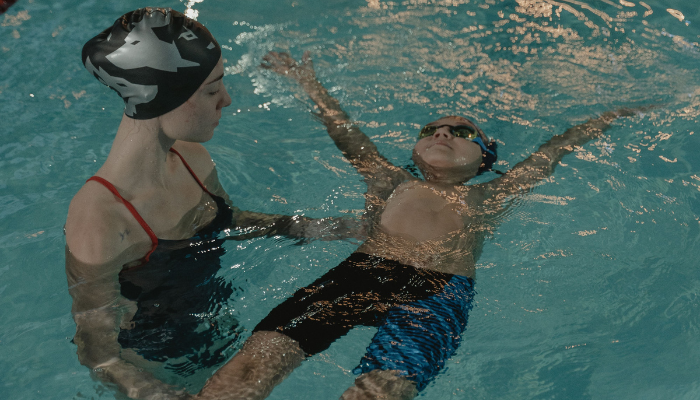
Here is something that surprises a lot of parents: the moment their child looks least like they are swimming is often the moment the real learning is happening.
Aquatots uses what is called purposeful play, and it is exactly what it sounds like. Toys, games, and activities that look like fun but are doing very specific technical work underneath.
Somersaults underwater are a proprioception exercise: the body is learning where it is in space, which is foundational for every stroke and for water confidence. Underwater movement is breath control. Digging for treasure at the bottom of the pool teaches reach, catch, and pull, the three phases of every effective stroke, reframed in a language a four-year-old finds genuinely motivating.
The reason this works is simple. A four-year-old who is told to pull their arm through the water correctly will comply for about thirty seconds. A four-year-old who is pulling treasure up from the deep is practising that exact movement, with full effort, for the whole lesson. The skill gets embedded because the child never felt like they were drilling.
On plateaus, and why they are not what they look like
One of the most common conversations Aquatots has with families is about progression. A child who seemed to be flying through skills three months ago is suddenly not moving at all, and occasionally appears to have gone backwards.
This is genuinely unsettling to watch from the poolside, especially when you have been committed and consistent.
The honest answer is that swimming progression is not a straight line. It follows a rhythm: a period of visible progress, then a plateau, then sometimes what looks like regression before the next leap forward.
A great deal of this is physiological. Growth spurts change a child's centre of buoyancy almost overnight. A child whose body has grown several centimetres in six weeks is not swimming in the same body they were swimming in last term, and their nervous system knows it even if they do not. What looks like forgetting is often the body recalibrating.
A trained instructor can tell the difference between a child who is regressing and a child who is consolidating. The cues are different, and so is the response.
Alena Sarri, who has spent more than 27 years teaching in the water, often uses the analogy of learning to walk. You would not pull your toddler out of walking lessons because they kept falling over at fifteen months. The only variable a family actually controls in this process is commitment and consistency. The instructor's job is to watch closely enough to know exactly what kind of patience the moment calls for.
The system behind the eyes
None of the observation skills described above happen automatically. They are taught, tested, and maintained through one of the most thorough instructor development programs in Australian swimming.
Before an Aquatots instructor teaches their first independent lesson, they work through a 21-module Dojo Certification Program, complete an Aquatots Boot Camp of 40 to 50 hours of internal training beyond their national qualification, hold a current CPR certification renewed annually at Aquatots' cost, and carry a nationally recognised Teacher of Swimming and Water Safety qualification. Many also hold specialist credentials in baby swimming and in teaching swimmers with disabilities.
Once they are teaching, the development does not stop. Professional development days run every term, hosted in-house and covered by Aquatots. Instructors who need support receive dedicated in-lesson help, not a warning. Lesson plans are provided. The management team is still in the water, which means quality control is firsthand, not theoretical.
That system has been built over more than two decades of continuous operation since 2002, with a curriculum reviewed every twelve months and an instructor team trained to watch the water the way described above: carefully, systematically, and with a specific outcome in mind for every child in every lesson.
So the next time your child is digging for treasure at the bottom of the pool, know that the instructor watching them is not just supervising. They are reading every movement, noting what is developing and what still needs work, and adjusting the next activity accordingly.
The splashing is the lesson. The lesson is working.
Want to see it for yourself? Book a free information session at aquatots.com.au and get a real picture of what learning to swim at
Aquatots looks like.