Article

A Drowning Risk We Do Not Talk About Enough: Overseas-Born Australians

New analysis from Aquatots shows that overseas-born Australians are at a higher risk of drowning. With National Water Safety Day on December 1, 2025, we need to ask: Are we reaching the communities at the highest risk?

Key findings


  • Over the last 20 years, people born overseas have often made up a bigger share of drowning deaths than their share of the population. In the late 2010s, they were about 30% of the population but up to 40% of drowning deaths.

  • In the five years before COVID (2015-16 to 2019-20), overseas-born Australians drowned at a rate about 25% higher than the overall population. This occurred while the national drowning rate improved. It suggests that overseas-born communities did not benefit as much as those born in Australia.

  • From 2005-06 to 2023-24, there were 1,627 drowning deaths among people born overseas - over 30% of all drowning deaths in that period.

  • From 2013-14 to 2022-23, the average annual drowning rate was 1.04 deaths per 100,000 for Australian-born residents. For overseas-born residents, it was 1.30. For Nepal-born people, it was 2.48, and for China-born people, it was 1.98.


Australia loves water, but not everyone is equally safe. Our analysis of 20 years of drowning data shows a clear pattern. People born overseas are often carrying more than their share of the grief.

Chart 1

Chart 1 shows how the picture has changed over time. 


In the mid-2000s, overseas-born residents were about a quarter  of the population. They were also about a quarter  of drowning deaths. 


Over time, that changed. By the late 2010s, people born overseas made up roughly 30%  of Australia’s population. But in some years, they accounted for around 40%  of drowning deaths.


A five-year bracket analysis highlights this shift (2024-25 excluded, overseas-born drowning data is provisional):


  • 2005-06 to 2009-10: overseas-born people were about 27% of drowning deaths.
  • 2010-11 to 2014-15: overseas-born people’s share rose to about 29%.
  • 2015-16 to 2019-20: it jumped to over 36%, more than one in three deaths.
  • 2020-21 to 2023-24: the share sits at about 29%.


This raises an important question. Is this simply due to the growth of the overseas-born population, or are overseas-born Australians actually less safe in the water?


To answer this question, we look at deaths per 100,000 people per year,  the crude annual drowning rate. For much of the last 20 years, the rate for people born overseas has sat above the rate  for the population as a whole (see chart 2).

Chart 2

In the five years before COVID (2015–16 to 2019–20), the drowning rate for overseas-born Australians was about 25% higher than the national average. In some of those years, the ‘extra risk’ climbed close to 40%. 


For most of the period, the risk ratio (shown by the yellow dashed line in Chart 2) is at or above 1.0. This means overseas-born Australians were as likely, and often more likely,  to drown than the average Australian. 


Since COVID, the two lines have moved closer together. Overall drowning has gone up, and the gap between overseas-born and Australian-born has narrowed. But the long-term story is clear; for many years, overseas-born Australians - including many culturally and linguistically diverse (CALD) communities were more likely to die once they entered the water.


The CALD communities cover many different communities. We focused on three large migrant communities: people born in China, India, and Nepal.


In 2005, the Nepal-born population in Australia was about 3,800. By 2024, it was around 197,800, more than 50 times larger. Over the same period, the India-born population grew by more than fivefold,  and the China-born population by more than threefold.


We used ten years of  Royal Life Saving National Fatal Drowning Database Dashboard data (2013-14 to 2022-23) and population figures from the Australian Bureau of Statistics. We calculated average annual drowning rates per 100,000 people and compared different groups (see chart 3).

Chart 3

Two things stand out from chart 3: 


  • People born in Nepal and China seem to have a higher risk of drowning. This risk is greater than the average for those born overseas and for the Australian-born population. 
  • People born in India have a lower crude rate, but India and Nepal together still account for around seven drowning deaths a year on average.


Across this time period (2013-14 to 2022-23), there were 933 drowning deaths among people born overseas. 181 of these involved people born in China, India, or Nepal, almost one in five overseas-born drowning deaths.

What this means for a drowning-free Australia


This study doesn’t explain all the reasons for the numbers. But it clearly shows that if Australia aims to reduce drowning deaths by half, CALD communities need to be included.


We know that overseas-born Australians face a higher drowning risk, it's time for specific action:


  • Make swimming lessons more affordable and culturally safe.
  • Offer water safety information in multiple languages.
  • Listen to CALD communities about the barriers they face and the support they need.


Recognizing these patterns and admitting the gaps is the first step to real progress. It’s key to a drowning-free nation where no family is left behind.

Methodology & Data Notes


Data Sources


  • NATIONAL DROWNING REPORT, Royal Life Saving Australia, several years
  • Royal Life Saving National Fatal Drowning Database Dashboard
  • 34090DO001_2024 Australia's population by country of birth 2024, Estimated resident population by country of birth - as at 30 June, 1996 to 2024, Released at 11:30 am (Canberra time) 30 April 2025, Australian Bureau of Statistics
  • A 10 YEAR NATIONAL STUDY OF OVERSEAS BORN DROWNING DEATHS, 2005/06 to 2014/15, Royal Life Saving Australia
  • Drowning Among Multicultural Communities in Australia, AN UPDATE: 2013/14 TO 2022/23, Royal Life Saving Australia


Formula


  • Crude drowning rate 

       (raw death count in the year/population of the year) * 100,000

  • Risk Ratio

       Overseas-born drowning rate​/Australian-born drowning rate

       A value above 1 means overseas-born Australians face higher drowning risk.


Note


  • 'Overseas-born' is not the same as 'CALD', our analysis focuses on country of birth
  • We used the Royal Life Saving National Fatal Drowning Database Dashboard to analyse the annual total drowning death counts. The dashboard reports 316 deaths for the 2023-24 period. National Drowning Report 2024, Royal Life Saving Australia shows 323. The difference does not affect any trend or conclusion in the analysis.

Using our work


Aquatots Research & Data Team's work is meant to be shared and used widely. You do not need to seek our permission to reuse our article, charts, data, you just need to provide credit - http://www.aquatots.com.au/a-drowning-risk-we-do-not-talk-about-enough:-overseas-born-australians

About Aquatots

Key takeaways at a glance

At Aquatots we understand children learn fastest through play. Play is what pulls together the logical and creative parts of the brain. For young children and babies, play is often a full body activity that helps them develop skills that they will need later on in life. The use of fine a gross motor skills while participating in our programs is enhanced by the use of equipment, toys and games. The tricky bit is the babies and children are developing the skills (and many more) that we require without even realising it most of the time as they are enjoying their time.


The Aquatots program has been designed to maximise your child's enjoyment, participation and development. We use toys and themes to make the classes fun and engaging. The toys and equipment we use not only assists babies in participation but also have other developmental advantages.


Toys that float can be used to teach cause and effect, when the toy is splashed it moves away or if it goes under it will pop back to the surface by playing with these types of toys your baby is learning how to control objects and what the cause of their manipulation is.


Floating toys are also great to encourage movement from your baby. When the floating toy is out of reach and you are not assisting your baby to move towards the toy they want, your baby will start to try and move by using their arms and or legs. When this occurs we encourage parents to make sure your baby gets to the toy as this will be their reward for propulsion through the water.


Floating toys can also be used as guides, Babies are very visual and they will copy what they see or follow the toy they want, by moving the floating toy and showing your baby where to go with the toy you will have their attention and a visual instruction of what to do.
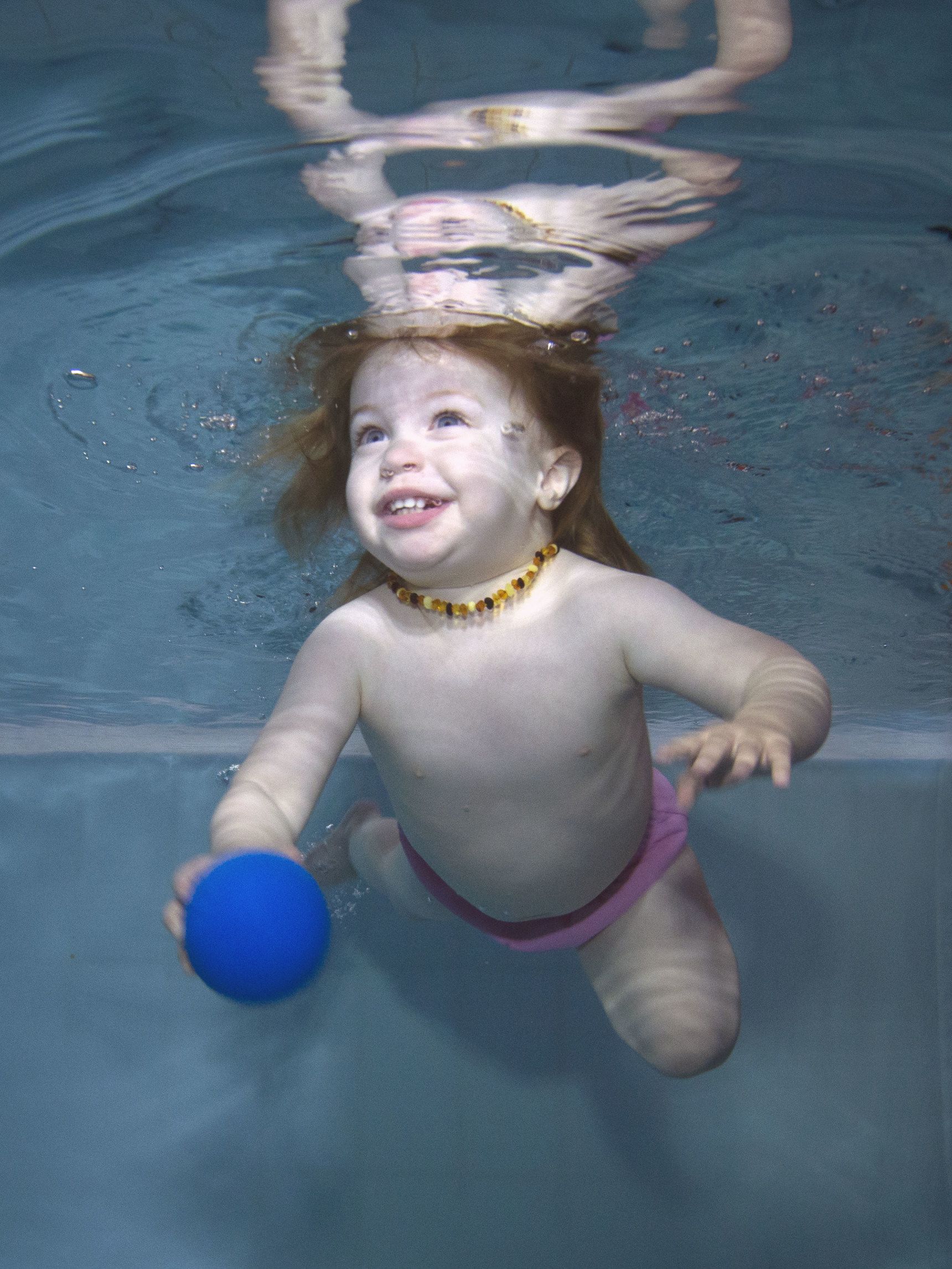
Toys that sink are great to encourage depth perception and breath control. Encouraging your child to reach under the water to collect a toy works on the development of their depth perception.


Showing your baby how to hold their breath and duck underwater to collect a toy teaches them correct breath control for swimming. When your child is ready the sinking toy can be used to control their breath and master basic breathing patterns for swimming, (when the toy is under, the baby ducks under and when the toy pops up, the baby pops up for a breath).


Sinking toys are also a great tool to use to gain correct head position when swimming. If the toys are on the bottom for the babies to swim over they will look down. Sinking toys can also be used to help your baby gain confidence with their own buoyancy.


Once you have helped your baby under to collect the toy, if you release them and allow them to resurface on their own they get an understanding of how their buoyancy works and become very comfortable in the water.


Mats, boards and islands are great tools to work on balance, core strength and confidence. Even if you little one is just sitting or standing on them they have to engage their core muscles to stay up right on the unsteady surface. These things can also be used for grip strength and floating.


Picking toys up, catching and touching toys and kicking toys work on muscle development and memory, while also helping to develop co-ordination. Swimming is the one sport that gives a complete body work out. As soon as we start to see the toys and equipment as tools of the trade rather than distractions you will find that they enhance your babies over all learning experience and development.


Allow your baby to explore the toys and what they do, allow them to have a go be a part of this exciting journey but try not to interfere and do it for them if they are struggling.


The number one rule in your swim class is to never get into a power struggle with your child. We only have 30 minutes to get the best out of your child and you will not win a fight in that time. If your child wants to use the toys or hold a toy, allow them to. Use the toys to encourage, distract or reward instead of seeing them as something that is hindering your child's swimming progression.


If you are unsure on how to use the toys available for the lesson plan please feel free to ask your instructor or contact us via email.
7 Simple Dryland Exercises For Strong Swimming
By Callum Gracie August 11, 2025
Build power, stability, and flexibility with these 7 dryland exercises for strong swimming. Boost speed, endurance, and technique in the pool.
Girl in swim gear, pink cap, smiling, holding award, with man giving peace sign at poolside.
By Callum Gracie August 11, 2025
From training habits to mindset, explore essential dos and don’ts for competitive swimming. Support your child’s journey with expert Aquatots tips.
Show More