Helping Kids Thrive Through Change: The Role of Positive Activities
Summary: How consistent activities like swimming can support children's confidence, routine, and emotional wellbeing as families navigate new chapters.
Every family goes through change. Sometimes it's a new school, a new baby, or moving house. Sometimes it's something bigger like a parent's illness or a separation. Whatever the change, parents ask us the same quiet question. What can I do to help my child feel okay?
The honest answer is smaller than most people expect. Small things, held steady. That's what the research keeps pointing to, and it's what we see in our work with Canberra families.
Change Affects Children, But Children Are Not Fragile
Australian children today are living through plenty. By age 14, around one in four lives in a one-parent family. That's up from one in ten under the age of one. Tens of thousands of Australian children each year experience their parents' separation. Beyond family change, more than one in five young Australians aged 15 to 19 reported high psychological distress. That's from the most recent Mission Australia Youth Survey.
So the picture is real. But here's the part that often gets lost in the conversation. The Australian Institute of Family Studies surveyed thousands of separated parents. Between 86 and 93 percent said their child was doing as well as or better than peers. That covered schoolwork, friendships, and wellbeing.
In other words, change is hard, but children are not fragile. What seems to matter most is not the change itself. It's the climate around it. Calm, consistent care from the adults in a child's world makes the biggest difference. That finding holds up across decades of Australian and international research.
So if you're reading this in the middle of a hard chapter at home, take that in. The goal isn't to protect your child from change. It's to keep their world steady while change happens.
Steadiness Looks Like Routine
Australian researchers and clinicians keep returning to the same idea: routine matters more than parents realise.
Andrew Fuller, one of Australia's most respected child psychologists, puts it plainly. Family rituals are strong predictors of resilience. And he's not talking about anything elaborate. The Sunday walk counts. The Friday pizza night counts. So does the Saturday morning swim.
Why does this work? Because rituals tell a child that the world is still the world. Bedtime is still at this hour. The weekend still has this shape. Something predictable is still happening, even when other things feel uncertain.
Justin Coulson, another well-known Australian voice on parenting, makes a similar point. Children do best when their lives are stable. Stability helps them feel secure, and that sense of certainty gives them the courage to explore and grow.
For families navigating separation specifically, this becomes essential. Emerging Minds, Australia's national children's mental health body, advises parents directly. Their guidance: stick to daily and weekly routines, and let children continue their usual activities like sport or music. The Raising Children Network agrees. Children cope better with family change when they can keep doing normal things like sport.
What's striking about all of this is how unspectacular it sounds. Children don't need grand gestures during hard chapters. They need the things they always needed, just held a little more carefully.
The Quiet Power of a Weekly Swimming Lesson
This is where activities like swimming earn their place.
Swimming looks, on the surface, like a physical skill. But what it offers a child going through change reaches well beyond technique. In 2012, Professor Robyn Jorgensen at Griffith University led the largest study of its kind in the world. Her team surveyed parents of around 7,000 children across Australia, New Zealand and the United States. They also tested 176 of those children with standardised assessments.
The findings surprised even the researchers. Children in regular swim lessons were six to fifteen months ahead of the general population on cognitive measures. The specifics tell the real story. Compared with the general population, swim children were 20 months ahead in understanding directions. They were 17 months ahead in story recall. And 11 months ahead in oral expression. So this isn't really a story about future Olympians. It's a story about what consistent, structured, small-class learning does for a developing brain.
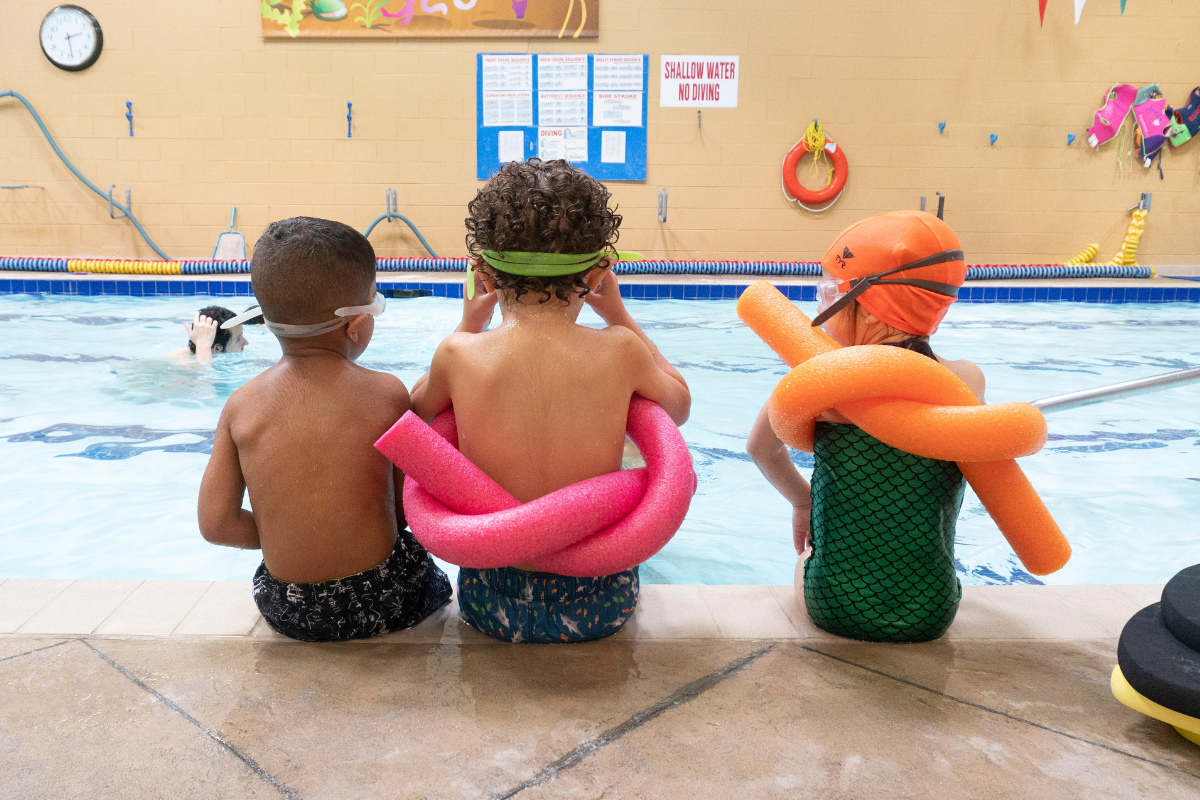
For a child whose home life feels unsteady, that one hour each week is something else, too. It's a relationship with an instructor who knows their name and remembers what they worked on last week. There's a small, predictable circle of other children. The lesson follows a sequence that repeats every time: change, warm-up, lesson, towel, snack. Nothing in that hour is asking them to be anything other than themselves.
The water itself adds something. Many occupational therapists describe the aquatic environment as naturally regulating. Pressure of water around the body offers what's called proprioceptive input. That input can have a calming effect on the nervous system. For a child carrying any kind of stress, an hour in the water can feel quietly restorative.
We've seen this play out in our work with separating families. The swim lesson stays. Mum's house, Dad's house, the extra logistics, the new bedroom, the new conversations. Through all of it, Tuesday afternoon at the pool stays. And children notice that, even when they don't have words for it yet.
What This Looks Like for Parents Navigating Change
If you're a parent reading this in the middle of a transition, the practical advice is simple. Pick one or two activities your child genuinely enjoys, and protect them.
Protect doesn't mean be rigid. Some weeks will be impossible. The point isn't perfection. The point is to keep the activity as a fixed feature of your child's week wherever you can.
Where possible, keep the timeslot the same across both households. Talk with your co-parent about who handles the swim run and how that gets shared. The clearer that arrangement, the less your child has to carry. Children sense logistical tension, even when they can't name it. So a calm handover at the pool gate is, quietly, part of the lesson.
Build a small relationship with the instructor. Tell them, gently, that there's some change happening at home. Good instructors will adapt without making a thing of it. Aquatots' approach groups children by readiness rather than age, and keeps the same instructor across terms. That structure supports exactly this kind of consistency. Their
swim programs are built around it.
Don't pile on extra activities thinking more is better. Family psychologist Dr Kimberley O'Brien suggests one activity during early primary years, with swimming as the essential one. Andrew Fuller calls it being "a counter-revolutionary." Keep some unstructured time at home, too.
And keep talking to your child. Activities are a wonderful scaffold, but they don't replace the conversations a child needs from their parent. They sit alongside them.
A Few Honest Caveats
A weekly swim lesson is not a fix, and we want to say that clearly. If a child shows real signs of distress, please reach out to your GP or a child psychologist. Watch for sleep changes, withdrawal, persistent irritability, or sudden behavioural shifts. Services like Kids Helpline are also available for older children directly.
Cost is real, too. Royal Life Saving Australia found that around one in three Australian schools doesn't offer swim programs at all. Swimming ability also varies widely by household income and location. So if budget is tight, ask your local council and the ACT Government about voucher programs and intensive holiday options. Aquatots also offers free adult learn-to-swim sessions and free CPR training for swim school families. We mention this because it speaks to access.
For families weighing up how to handle separation, the goal is keeping the children's world as steady as possible. Working with a
family law team that prioritises kindness and low-conflict resolution can make a meaningful difference here. The lower the conflict between parents, decades of research consistently show, the better children fare on the other side.
A Final Thought
Children who do well after a hard chapter aren't the ones who avoided change. They're the ones who had ordinary anchors holding them while change moved around them. A warm relationship with a parent. A regular bedtime. Friends they see each week. An hour at the pool every Tuesday afternoon.
These things are small, and that's the whole point. Change is loud. What holds children steady through it is quiet.
Aquatots'
Swim Safety and Access Gap Index report explores why early, sustained access matters for Australian children's long-term safety and confidence.
For more support on the legal and practical side of family transitions,
Balance Family Law's resources offer calm, child-focused guidance.
To any parent reading this: you're already doing more than you know.